Showing posts with label installation. Show all posts

Thursday, 11 February 2010

Windshape


"Windshape was an ephemeral structure commissioned by the Savannah College of Art & Design (SCAD) as a venue and gathering space near their Provence campus in Lacoste, France. Built by nARCHITECTS and a team of SCAD students over a period of five weeks, Windshape became the small town’s main public meeting space, and hosted concerts, exhibitions, and ceremonies throughout the summer of 2006. Windshape was conceived as two eight-meter-high pavilions that dynamically changed with the Provençale wind. A vine-like structural network of white plastic pipes, joined together and stretched apart by aluminum collars, emerged from the limestone walls and terraces of Lacoste’s hillside. Fifty kilometers of white polypropylene string was threaded through the lattice to create swaying enclosures. The string was woven into dense regions and surfaces and pinched to define doorways, windows, and spaces for seating. By varying the degree of tension in the string, nARCHITECTS built Windshape to respond to the wind in several ways, from rhythmic oscillations to fast ripples across its surfaces. During heavy winds, Windshape moved dramatically, and made a hissing sound akin to dozens of jumpropes. The pavilions took on a multitude of temporary forms over the course of the summer, as they billowed in and out, and momentarily came to rest. In this way, the local winds and the Mistral gave shape to constantly mutating structures. The pavilions were illuminated at night against the backdrop of the Marquis de Sade’s castle, and were visible from as far away as the village of Bonnieux, 5 kilometers away. The pavilions’ design reflects a desire to remix the hard and soft landscapes of Provence in an innovative tectonic system. The village of Lacoste appears hewn out of limestone, its streets and network of terraces seemingly chiseled out as voids in the hillside. In contrast, the surrounding fields, vineyards, and lavender bushes form a luminous, soft, and changeable landscape. Windshape refers in its exterior form and angular geometry to the medieval townscape, while echoing the mutating, softer agricultural landscape in its internal experience and dynamic qualities.

Windshape was a laboratory that allowed us to test the idea of a building that can respond to natural stimuli. Rather than simply sheltering us from the elements, buildings of the future could connect inhabitants to their environment, reminding them of its strength and beauty.
Windshape was constructed by nARCHITECTS and a team of SCAD students over a period of five weeks. The architects developed a construction sequence that optimized the use of measured and non-measured fabrication methods. The basic components of string, plastic pipes and aluminum collars were all digitally modeled and translated into a set of 2D drawings and data. To achieve the project’s complex, interwoven geometries, the pavilions were built as a series of stacked and staggered “tripods”. Comprised of groups of three pipes inserted into an aluminum collar, the tripods were pre-assembled, woven with string on the ground, and hoisted in place. Interstitial string surfaces were then woven in between the tripods in the air.

nARCHITECTS exploited the different properties of two weak and supple materials to create a strong yet elastic structural network. Similar to an archer’s bow, the pipes were placed in bending and the string in tension to achieve structural integrity as well as a desired range of movement in the wind. The interdependent structural system of string, pipes and collars required a flexible fabrication method. An initial stitching of string through the pipes allowed for improvisation in weaving strategies to provide enclosure, openings or stability. In this way, Windshape’s indeterminate structure relied equally on precise translations from digital models as well as in-situ building tactics."

Monday, 23 March 2009

Ready Made Art - Plastic Bags 1


"
In the early morning Thursday 5 March, 80 plastic shopping bags were reused by Luzinterruptus to lit ended floating in the wind in The Prado Museum.

The intervention was called ´A Cloud of Bags visit The Prado´and it was a success thanks to the wind that blew through the city on this particular day.

The installation was rather ephemeral we thought that before dawn it would have been dismantled by the Cleaning Service who are always ready to leave everything spik and span and enable everybody to enjoy such a magnificent building. We hope that as we always mention the components of the intervention were recycle.

Despite its short duration we kept our memories have been im mortalized by Gustavo Sanabria's
photos.

Time of installation : 1 hour 20 minutes.
Damages: none
Exhibition time:
4 hours."

via luzinterruptus

Saturday, 21 March 2009

Performing Landscape


Recently I was brainstorming on an ideas competition for the Arts Center in Melbourne and exploring the possibility of integrating performing arts opportunities in public space - that the urban landscape can do more to facilitate performing arts than just allowing for enough hardscape space for the Spiegeltent to set up every year. I wondered if there were ways that the Arts Center could engage with the public on a more personal, one to one, basis and with children to ensure that the instituion stays relevant for the next generation. One of the ideas was "performing space", where all the elements in the landscape could be used for "performing", whether that be music, dance, theatre etc. For example, I wanted to redesign the standard green Melbourne street bench into a xylophone that children could play with. The closest realised project that I found in a precedent search was "Railings" by Greyworld, a standard looking railing in London which plays the Girl from Ipanema when you run a stick along them.


Sadly, the project architects I was collaborating with didn't want to hear about such minor details as the street furniture (or for that matter, the landscape) and the ideas were never communicated to the client but it got me thinking generally about how to extend the functions of street furniture, which is a standard public amenity that is installed all over the city. Then I came across this "bouncing bench" project by Bruno Taylor which I would love to specify for the next playground I am designing if its in production by then.


And playful fencing to keep the children in :) via Inhabitat

via pixelsumo

Wednesday, 29 October 2008

Investment Banker In Formaldehyde


Living in London, it is impossible to avoid the (hyper)reality of the Global Credit Crunch, every day there are new record breaking statistics on just how bad the situation is - the number of jobs lost, the number of homes repossessed, the falling pound... its seems to be never ending. I can't work out if it really is that dire or if there are just a lot of Indian nationals working in the London media these days. At least I no longer see bankers in expensive suits going home on the tube carrying boxes of their belongings. Which leads me to the best piece of humor I have come across in reference to our current troubled times.

Damien Hirst sets new auction record with ‘Investment Banker in Formaldehyde’

A piece of art by Damien Hirst has set the new record for a single item at auction. The piece entitled ‘Oh Shit’ fetched £2.3bn after frantic bidding by an anonymous investor. The work, which features a Merrill Lynch employee suspended in a tank of formaldehyde secured the highest price yet paid for a single piece of banking history.

It was believed that it was purchased for a private exhibit, and is unlikely to be put on display to the public or auditors, in the immediate future. ‘Pay Day’, a piece comprised of empty envelopes and which was expected to make between 4,000 to 5,000 people happy, eventually went to administrators Price Waterhouse Coopers for well over the asking price.

Art critic Mathias Van-Leer praised Hirst for his courageous decision to sell all these works from his Financial Meltdown period. ‘It is a remarkable that Damien has been able to command these sort of prices,’ he said, ‘especially as we are seeing a lot of similar pieces suddenly coming onto the market.’

The success of the Hirst auction is in contrast to the fortunes of artists and brothers Jake and Dinos Lehman who were unable to find a buyer for their latest work, ‘White Elephant’. This has led some art experts to claim that the market will be unlikely to secure the same sort of money for other historic banking institutions, and some predict that the bubble will burst sooner rather than later. Daily Telegraph art critic Mark Walker-Brice is one of the sceptical voices; ‘I mean we’ve seen this all before, haven’t we? I mean, this is just Northern Rock Bank Clerk, given a transatlantic sheen and passed off as the next big thing.’

Meanwhile, Hirst’s agent said he was delighted at the amount raised by the sale of his latest work. ‘Although we’re a bit worried about where he should deposit the cheque.'

via NewsBiscuit

Friday, 18 April 2008

One Day Poem Pavilion

I have been having an "interesting" time recently with the concept of canopies and shade structures on a project in the Middle East. We suggested 'em > the client wanted 'em > we designed 'em > the client doesn't want 'em anymore > somebody found the shadow studies and realised that we don't actually need 'em > but now the boss wants 'em... just great... anyway, the One Day Poem Pavilion by Jiyeon Sung is an amazing project that tracks the sunlight with a moving poem. These is a time lapse video too. I wonder if this can be made to work on a very large scale.

Sunday, 25 November 2007

Tis the Season...


I pronounce the Silly Season... OPEN ~

Hannes Broecker - Drink Away The Art
Exhibition in Dresden, Germany

"Forget about wandering through an art gallery and wondering if you’re the only one who has no idea what anything means. Hannes Broecker has brilliantly invited the cultural elite to grab a glass at an exhibition in Dresden, Germany, and drink away the art. Regardless of what we do or do not understand about art, we can all agree, it stimulates our senses. Broecker has aroused our sense of taste (not to mention eliminated the need of elbowing our way to the bar) by hanging flat, glass containers with a variety of cocktails in the exhibition space. As the night progressed, the levels of the multi-coloured infusions diminished. By the end of the event, the art, itself, ran dry, and empty drinking glasses were returned to where they were originally placed. By Andrew J Wiener."

via Coolhunter

‘under-construction sites’

"Fulton Fence is installed on the corner of Fulton Street and Broadway in Manhattan, New York and can be viewed 24 hours a day, 7 days a week. The project is on of the three interventions that make the pilot Re:Construction public art program organized by the Downtown Alliance and the LMCC.

Project Description

Accents of orange and yellow plastic construction meshes, industrial caution lights, safety signage and the chain-link fencing that universally signify construction-in-progress will be collaged into a vibrant op-art mural bounding the water main retrofitting on Fulton Street. These treatments will be affixed in segments following the 10-foot long section frames of chain-link fencing that currently encircle the construction site. At the time of installation the team will establish a primary linear pattern along the line of the fence that combines 30 or more of these modules. As these modules get moved around by the contractors due to on-going construction needs, these new arrangements will create unpredictable patterns conveying the very history of the construction as it progresses.

As part of the piece, the team will continually be building a web-based project, which will become the location of an online intervention that seeks to parallel the construction of the physical site with the construction of a ‘space’ within the Internet. This digital destination takes the form of a continually scrolling web page as both an organizational tool and analog of strolling down the perimeter of the project on Fulton Street. Just as the physical installation weaves elements of vernacular construction materials into the frame of the fence, the website will embed media driven ‘interventions’: process documentation, location information, online widget mash-ups, and mobile downloads among others.

These two explorations – one architectural, the other online – seek to re-define ‘under-construction sites’ as expressive spaces in a city of ongoing transformation."

Fulton Fence . net

Thursday, 22 November 2007

Cracks at the Tate


Would have loved to be there for the briefing meeting for the engineer who made this happen... Maybe Gehry should use the "But, your honor, its art!!" defense for the Stata Center case.

Doris Salcedo Shibboleth

Doris Salcedo’s Shibboleth is the first work to intervene directly in the fabric of the Turbine Hall. Rather than fill this iconic space with a conventional sculpture or installation, Salcedo has created a subterranean chasm that stretches the length of the Turbine Hall. The concrete walls of the crevice are ruptured by a steel mesh fence, creating a tension between these elements that resist yet depend on one another. By making the floor the principal focus of her project, Salcedo dramatically shifts our perception of the Turbine Hall’s architecture, subtly subverting its claims to monumentality and grandeur. Shibboleth asks questions about the interaction of sculpture and space, about architecture and the values it enshrines, and about the shaky ideological foundations on which Western notions of modernity are built.

In particular, Salcedo is addressing a long legacy of racism and colonialism that underlies the modern world. A ‘shibboleth’ is a custom, phrase or use of language that acts as a test of belonging to a particular social group or class. By definition, it is used to exclude those deemed unsuitable to join this group.

‘The history of racism’, Salcedo writes, ‘runs parallel to the history of modernity, and is its untold dark side’. For hundreds of years, Western ideas of progress and prosperity have been underpinned by colonial exploitation and the withdrawal of basic rights from others. Our own time, Salcedo is keen to remind us, remains defined by the existence of a huge socially excluded underclass, in Western as well as post-colonial societies.

In breaking open the floor of the museum, Salcedo is exposing a fracture in modernity itself. Her work encourages us to confront uncomfortable truths about our history and about ourselves with absolute candidness, and without self-deception.

more here...

Tuesday, 31 July 2007

Wind to Light


Recently I was in windy Wellington for a 24hour design competition, where I was memerised by the colour of the water, highly amused by the proliferation (four) of strippers surrounding the School of Architecture and Design and informed that the Mayor had recently committed the city to Carbon Neutrality (more here) . Then I read about the Wind to Light project and thought... just maybe...

Artist
Jason Burges Studio in onedotzero words
"this experimental site-specific installation illustrates alternative, sustainable ways of harnessing energy that will explore the power of the wind in the city, visualising it as an ephemeral cloud of light. the installation is custom built, using 500 mini wind turbines to generate power, which illuminates hundreds of mounted leds, creating firefly-like fields of light, with wind visually interpreted as electronic patterns across the installation. wind around the southbank generates the power, creating a unique and thought-provoking light art piece that will delight all ages. commissioned by riba london and onedotzero for architecture week 2007"

onedotzero presents: jason bruges studio wind to light in conjunction with riba london and southbank centre lightlab

Sunday, 22 July 2007

Rice Paddy Art

I always considered the japanese as pretty OTT people but even I was surprised at this. Apparently "...every year since 1993, farmers in the town of Inakadate in Aomori prefecture plant purple and yellow-leafed kodaimai and green-leafed tsugaru-roman in just the right arrangement that when they begin to grow, works of art emerge...". If only my contractors in Melbourne were as precise with their setouts on my projects as these Japanese farmers.

via the Underwire
more images here

Tuesday, 10 July 2007

'inversion' 'tunnel' 'vortex'

'inversion' by dan havel and dean ruck, 2005
two wooden buildings used for over thirty years to hold exhibitions and art classes years by Art League
were converted into a 'vortex' like installation for the last few months before their demolition. read more

i would love to see photos of the construction process of this...

via designboom

Hello, world!

I was doing some research on crop circles and the like for a project out in Berwick where I am proposing rooftop agriculture (can't wait for the community feed back when it goes into town planning) and came across this interesting geeky project...

In the artist's words
"“Hello, world!” is a real installation for the virtual globe of the software Google Earth. A Semacode measuring 160 x 160 meters was mown into a wheat field near the town of Ilmenau in the Land Thuringia. The code consists of 18 x 18 bright and dark squares producing decoded the phrase “Hello, world!”.

More images here

Sunday, 10 June 2007

House Swarming


Designed by Jenna Didier, Oliver Hess and Marcos Lutyens
In the Artist's words

"
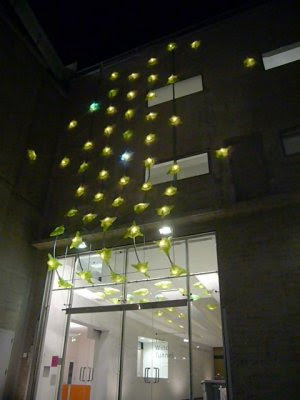
Commissioned for the Art Center presentation of “Open House,” this site-specific installation operates both as a complex light pattern that greets visitors and as an environment-sensing device.

During the day, the “swarm” of green ambiguous forms, both biomorphic and geometric, accentuates the South Campus’s main entry. At twilight, the swarm comes to life, telling visitors and passersby about the current air quality around the building. Electronic sensors perceive air contaminants – such as tobacco, benzene, carbon monoxide, even perfume – and separately inform the outside and inside swarms, which sets off signals. These signals are interpreted as changes to the natural rhythm that the network has established based on the number and distribution of nodes connected to the cable net. Flashing cells on the exterior faÁade indicate air quality inside the building. Conversely, pulsating effects in the interior entry inform visitors about the outside air quality. The flashing lights become indicators of the environment like dramatic clouds at sunset that forewarnings of storms at night.

HouseSwarming is an example of how architects and designers are using technology that mimics biological systems. These patterns look like those structures found in nature, such as the patterns made by schools of fish, flocks of birds, and swarms of locusts. Used in the home, this type of sensor-node technology could enable us to extend our nervous system into the environment and alter our sense of boundaries."

check out the video here
via The Underwire